

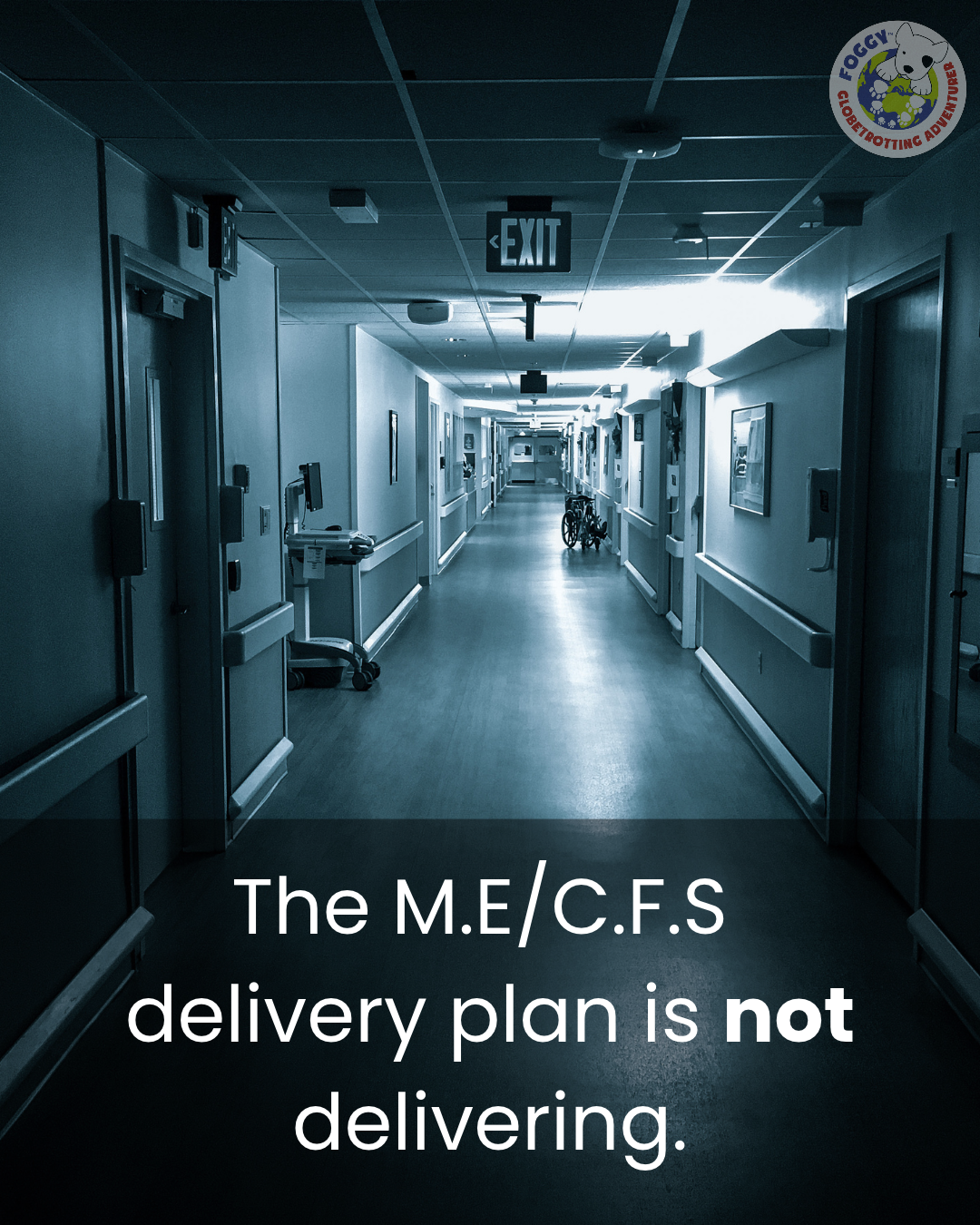
As part of BED for Severe M.E 2026, I want to talk about something that has increasingly concerned me over the last few years. It is not an easy topic to write about because I know how much work went into developing the M.E./C.F.S. Delivery Plan, how many people from the M.E community contributed to consultations, and how hard stakeholders fought to have their voices heard. However, I have reached a point where I believe an honest discussion is needed about the role the Delivery Plan is now playing within the M.E landscape. Ironically, what was intended to be a vehicle for progress has, in many respects, become a barrier to it.
Let me be very clear from the outset. This is not a criticism of the people with lived experience, carers, charities, organisations, clinicians, researchers, and advocates who contributed to the development of the plan. Nor is it a suggestion that the stakeholder organisations involved somehow failed. In fact, several stakeholders have publicly expressed disappointment about aspects of the plan and concerns about the pace of progress. I have immense respect for the effort that went into trying to make the plan as strong as possible, the problem lies elsewhere.
The problem is that the existence of the Delivery Plan is increasingly being treated by governments, health departments and policymakers as evidence that the work is already being done. Time and time again, whenever I raise an issue, with either of my social enterprises, that is affecting people with M.E, propose a solution to a longstanding problem, or campaign for meaningful change, I find myself receiving responses that point back to the Delivery Plan, it has become the standard UK Government’s Department for Health and Social Care response. The assumption appears to be that because there is a Delivery Plan, concerns are already being addressed and additional action is either unnecessary or premature.
For me, this has become one of the biggest frustrations of campaigning since around 2021.
How I campaign has never really changed, I’ve always been drawn to the gaps, whether that was crowdfunding for and creating an online M.E/C.F.S. training platform in 2018 when nothing similar existed, co-producing #MPDoYourJobForME when people with M.E were being failed by hospitals and their MPs, or more recently developing campaigns around NHS protocols, harm reporting and hospital care. I don’t tend to work on things that are already being done; I focus on the problems that are still being missed. Perhaps that’s the adventurer in me, and in Foggy too, venturing into areas where nobody else has quite gone before. The downside is that it can be incredibly frustrating. Time and again I raise a flag to say, “There’s a gap here and patients need help,” only to be pointed back towards the Delivery Plan. After a while, those responses start to feel less like engagement and more like a brick wall. When the gap still exists, being told that a Delivery Plan exists goes down about as well as a bucket of cold sick. What I need is a conversation about the problem I’ve identified, not a reminder that a plan exists which still isn’t addressing it.
The difficulty is that many of the gaps I am highlighting are not actually addressed by the Delivery Plan.
ME Foggy Dog’s NHS Protocol Campaign is perhaps the clearest example of this.
In February 2024, I launched a campaign calling for the creation of a dedicated NHS protocol for severe M.E. The reason for this was straightforward. While NICE guidance provides important recommendations, guidance alone does not create a functioning healthcare pathway. It does not tell hospitals precisely how to respond when a patient with very severe ME is admitted. It does not provide clinicians with a practical operational framework for supporting patients whose illness may leave them unable to tolerate light, sound, touch or basic physical exertion. It does not establish a consistent approach across the country for managing the complex needs of those who are housebound or bedbound.
Recognising this gap, I wrote an open letter to the Secretary of State for Health and Social Care in 2024 (this open letter has now been signed by 5937 people – please sign if you haven’t done so already) outlining the urgent need for a dedicated NHS protocol. In that letter I argued that severe M.E patients were being left without adequate medical support because no such protocol exists. I highlighted the need for specialist care pathways, better education and training for healthcare professionals, meaningful patient involvement, and a framework that would enable clinicians to provide safe and consistent care. I also raised concerns about the difficult position that knowledgeable doctors can find themselves in when trying to support severe M.E patients in the absence of clear NHS structures and guidance.
I considered the issue urgent then, and I still consider it urgent now.
I have never received a commitment to develop , or even discuss, an NHS protocol. What I received was yet another response pointing towards wider M.E./C.F.S. work and the Delivery Plan.
This is precisely the problem I am raising in this blog.
In fact, the more work I have done on this issue, the more convinced I have become that there remains a significant operational gap at the centre of M.E healthcare. As I outlined in my submission to the Health and Social Care Committee, NICE guidance explains what good care should look like, but there remains no operational mechanism that consistently translates that vision into real-world practice. Without that missing layer, service provision remains inconsistent, severe patients remain particularly underserved, and Integrated Care Boards (and other regional healthcare bodies around the UK) are left without the practical framework needed to commission services effectively. The one page summary I wrote for the DHSC on ‘Operational Gaps in M.E./C.F.S. care’ in recent months specifically identifies this operational gap and argues that the aims of the Delivery Plan cannot be fully realised until it is addressed.
The same pattern can be seen in another campaign that I have been pursuing since 2021: the campaign for a reporting system for harms arising from non-pharmaceutical treatments. This campaign emerged from a simple question. If patients are harmed by a medicine, mechanisms exist to report that harm. Data can be collected, patterns can be identified and safety concerns can be investigated. But what happens when harm arises from a non-pharmaceutical intervention and why was there no centralised evidence of harms available during the NICE guideline review in 2021? Our community knew that hundreds, if not thousands, of complaints had been submitted to ‘CFS clinics’, CCGs (as was), and PALS over the years.
Within the M.E community, discussions about harm are not theoretical. Patients have spent decades describing negative outcomes associated with interventions that failed to properly account for post-exertional malaise and the unique nature of M.E. We know that inappropriate approaches can cause deterioration, we also know that negative patient experiences exist. Yet we still lack a centralised mechanism for systematically recording those harms.
Without data collection, there is no evidence base. Without an evidence base, concerns can be dismissed as anecdotal. Without a reporting system, the true scale of the problem remains hidden.
This campaign is attempting to address a problem that has remained unresolved for far too long by creating a mechanism through which harms arising from non-pharmaceutical treatments and interventions can be formally reported, recorded and understood. Without such a system, patients have no meaningful way to document their experiences, regulators lack the data needed to identify concerning patterns, and policymakers are left without the evidence required to understand the true scale of the issue. Yet whenever this gap is raised with decision-makers, the conversation frequently shifts back to wider Government activity and the M.E./C.F.S. Delivery Plan. The difficulty is that, while the Delivery Plan may contain commitments relating to M.E./C.F.S., it does not contain a harm reporting system. It does not create a database of adverse events, provide patients with a route to report harms, or generate the information that regulators need to identify problematic practices. As a result, the fundamental problem that prompted this campaign continues to exist, despite repeated references to the Delivery Plan as evidence that progress is being made.
The same can be said of the M.E.-Friendly Hospital Charter that we launched in October 2024 during BED for Severe ME. Developed with members of the M.E. community and NHS representatives, the Charter was designed to tackle a problem that countless patients have experienced first-hand: exclusion from healthcare. Too many people with M.E continue to enter hospital environments that are fundamentally unsuited to their condition. Too many are expected to explain post-exertional malaise, sensory sensitivities and activity limitations while acutely unwell. Too many are placed in situations that worsen symptoms because healthcare professionals have not received the education or support they need.
The Charter represents one attempt to improve that situation. It is designed to complement existing initiatives, not compete with them. Yet even here, I have encountered a tendency to point back to the Delivery Plan, as though the existence of a national strategy somehow removes the need for practical tools that could improve healthcare delivery today.
What concerns me most is that this pattern is becoming normalised.
Recently, I was informed that the Northern Ireland Health Department intended to look at England’s Delivery Plan when considering future actions to take for people with M.E. On one level that sounds encouraging, on another, it perfectly illustrates my concerns. The Delivery Plan itself is gradually becoming the benchmark against which progress is measured, despite the fact that many of the issues patients are raising remain unresolved.
The reality is that years have passed since the work on the Delivery Plan began. Throughout that period, patients have continued to become severely ill, families have continued to struggle, housebound and bedbound individuals have continued to wait. Despite all the discussions, consultations and commitments, there are still glaring gaps in healthcare provision that need urgent attention.
That does not mean the Delivery Plan has no value. Nor does it mean it should be abandoned. What it means is that we must stop treating it as though it is sufficient in itself. The Delivery Plan should be viewed as a foundation for further action, not as a reason to avoid it. Whenever patients, carers, charities or campaigners identify gaps that remain unaddressed, policymakers should be willing to engage with those concerns on their merits rather than simply pointing towards the existence of a Delivery Plan.
As part of BED for Severe ME 2026, I want to encourage our community to help start that conversation. On 29 October, I am asking people with M.E, carers, advocates and allies to share on social media why they believe the M.E./C.F.S. Delivery Plan is not delivering. What gaps remain? What have you been waiting for? What support do you still lack? What changes would have the greatest impact on your life? You can find downloadable images and copy and paste text templates (if you are unsure what to post) here to add to your social media post.
Most importantly, I want policymakers to understand that this campaign is not about attacking the Delivery Plan or criticising the stakeholders who worked on it. It is about recognising that there is still a huge amount of work left to do. The needs of people with M.E extend beyond the boundaries of any single plan or policy, and if we genuinely want to improve lives, we must be willing to support initiatives that address the gaps that remain.
Because for those living with severe and very severe M.E., the question has never been whether a Delivery Plan exists.
The question is whether it is delivering the change that patients have waited far too long to see.