

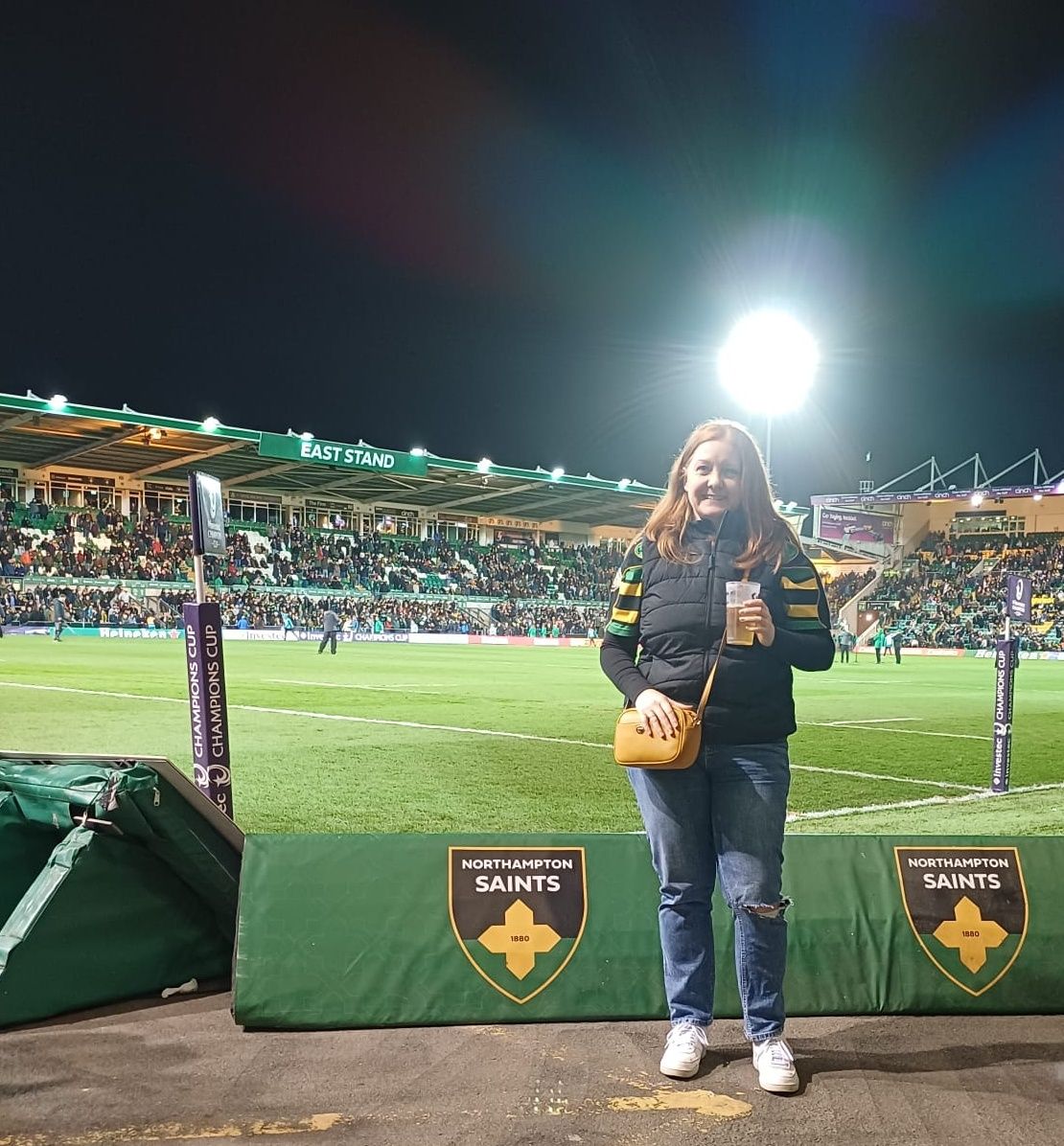
This blog is an informal write‑up of my recent trip to watch a Northampton Saints rugby match. It’s taken me a full week to have enough energy to write it, which probably tells you everything you need to know before you start reading.
Before anything else, I need to be clear that I rested as much as possible for five days before the trip. I knew the energy demand would be far beyond my usual limits. For those unfamiliar with M.E., even being a passenger in a car requires energy. This trip involved a four–to–five-hour round drive on motorways and dual carriageways, so I knew it would be a lot before even reaching the stadium.
Thankfully, Foggy’s Chauffeur (my Dad) was also attending and was more than happy to take on driving duties. I am physically unable to drive that far and still be functioning when I arrive at my destination!
Back in January, I decided to mark my 50th birthday (in October 2026) with a “birthday year” focused on doing things I love. Many of these are things I haven’t been able to do for at least six years, due to a combination of the pandemic, the cost-of-living crisis, and a worsening of my M.E. I also no longer have the friendship circle I had a decade ago, and I didn’t want a party that I’d have to organise myself. Instead, I chose to spread out a series of experiences, some I haven’t done in years, others I’d always wanted to do.
One of those was attending a Northampton Saints match at Franklin’s Gardens, something I hadn’t managed for well over a decade.
When I saw an advert for the Good Friday match against Castres Olympique, I asked my Mum and Dad if they fancied going, and things snowballed from there. In the end, Mum decided not to come. The hotel wasn’t accessible (no lift and no ground-floor rooms), and we knew there would be walking involved from the car parks to the stadium, something she struggles with due to mobility issues. She stayed home to dog‑sit Maggie instead. I’m not sure how Maggie felt about being denied a deluxe stay at the kennels, but she seemed perfectly content!
The trip also doubled as a chance to catch up with family, including my cousin, who joined us at the match. The afternoon before kick-off was essentially “Operation Rest As Much As Possible” until we left for the stadium around 6.30pm for an 8.00pm start.
We were extremely lucky that a friend of my cousin, and a season ticket holder, was also going. He kindly drove us from Towcester to Northampton and knew exactly where and when to park to make things as easy as possible. It’s worth noting here that I was the only person under 68 in the car, so age, as well as accessibility, played a big part in how the evening unfolded.
Accessibility and Inaccessibility Issues
Unfortunately, several aspects of the matchday experience highlighted significant accessibility problems:
- Digital-only entry
Stadium access relied on QR codes on phones. When our friend’s phone had issues, he had to trek to the ticket office to sort it out, making us all late getting inside. Paper tickets need to remain an option, or at the very least, ticket desks should be positioned close to entrances. - Fan zone (what I like to call ‘The Pen’, I felt like cattle)Having the fan zone immediately inside the gates felt like a serious design flaw. Mobile bars, queues of people, and extremely loud music from the entertainment tent created a bottleneck that everyone had to pass through to reach the stadium/their seats. It was packed, noisy, and didn’t feel safe. I could hear people shouting because they’d lost family members in the crowd, some of them children.I understand the motivation to create atmosphere and appeal to younger fans, but placing it here risks alienating others. Long COVID now affects many people, and those of us with chronic or energy-limiting illnesses might manage the main event occasionally, but these additional sensory and physical barriers make attending much harder. Quiet spaces and seating would be far more inclusive than forcing people through loud, crowded areas simply to reach their seats.
- Blocked walkways inside the stadium
Once inside, we encountered further queues caused by player engagement activities with young fans. While this is a lovely idea, placing it next to a narrow (around five-foot-wide) walkway created a serious obstruction. People stopped to watch, crowds built up, and eventually our group had to climb over rows of seating to get around the blockage.The oldest member of our group was 76. A 76‑year‑old should not need to climb over seating to reach an aisle. This felt like an entirely avoidable health and safety issue. Could these engagements take place in a tunnel or designated space rather than blocking a main route?
What made this more frustrating was finding older guidance from Franklin’s Gardens (post-refurbishment) acknowledging that walkways can be a problem and asking fans to help keep them clear. If this is a known issue, why create blockages through organised activities before kick‑off?
While Franklin’s Gardens has excellent wheelchair provisions, other disabilities and mobility or energy-limiting conditions appear not to have been seriously considered. Wearing my M.E. advocacy hat, I would strongly suggest:
- Designated rest and quiet areas, ideally with sound damping (would benefit people with a wide-range of conditions)
- Reducing the amount of standing and walking required to attend (seating outside the stadium would be good!)
I’m not naïve, I know noise, crowds and busyness add to the match-day atmosphere. But they are also excluding increasing numbers of people from attending at all. With Long COVID still rising, this affects existing season ticket holders and potential future fans alike. Ultimately, that impacts the club financially too.
One final point: our driver insisted we leave five minutes before the end. I wasn’t thrilled, especially if the match was close, but he explained that post‑match press activity often blocks walkways and traps crowds inside the stadium. For me, that kind of delay would have made getting back to the hotel, and resting, significantly harder.
Again, this feels avoidable. Could the press area be moved somewhere that doesn’t obstruct walkways and exiting? After a match, when people may also be tired or have had a drink or four, impelling them to clamber over seating to leave is an accident waiting to happen.
Despite all of this, I had a fantastic time. I overindulged in fun, noise, and alcohol (and paid for it badly the next day, I’m alcohol intolerant but temporarily forgot that fact). The experience showed me that attending a match is something I can manage as an occasional treat, but it’s not realistic on a regular basis. That’s a real shame, but until venues become genuinely friendly to people with energy‑impaired conditions, I’ll have to remain an armchair supporter.
Oh, and Saints won!
There’s another match on tonight, and I’ll be watching it from the comfort of my sofa while still recovering from last week’s adventure.
I’d be more than happy to talk to Saints management about practical ways they could improve inclusion for people with energy‑limiting illnesses.
Sally